Johnathan Wilborn
Field Study, Vision Board
26 September — 5 November 2026
the words I can make it real, she thought, and that was when she sat down to be a writer.
Anne Carson, Wrong Norma
In 1671, the French Royal Academy of Painting came to be the theater of what would become a historical controversy: a conflict of taste and power over the aim and form of painting. The Poussinistes located painting in dessin, the line through which the mind orders the world. The Rubénistes located it in color, in what the eye receives before the mind intervenes. Color eventually won its place, but the suspicion outlived the quarrel: because it belonged to the senses, color was immediate at best, naive at worst, while depiction was of the mind.
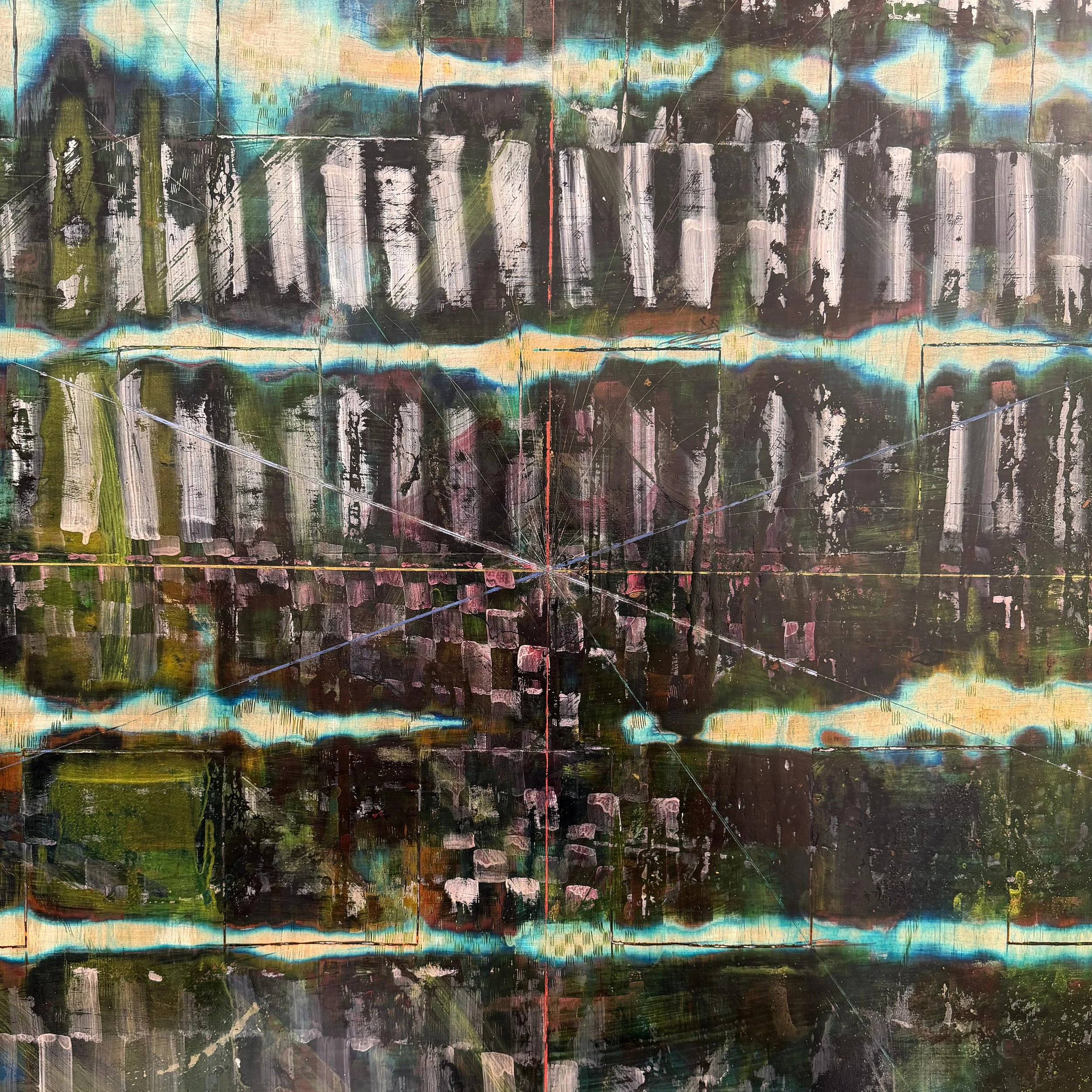
Johnathan Wilborn's reflection paintings begin with a photograph of the artist reflected in a vitrine. Street, glass, merchandise and onlookers fold into a single plane. The process recalls the Claude glass, a darkened convex mirror in which eighteenth-century painters and travelers looked at the landscape behind them, so that the environment returned to them as an image before it was ever a view. The Claude glass required the viewer to turn his back on the scene and vanish from it. Wilborn stays in the picture. For the sublime is punctured by egotism, by the rapt, hard, small beak of my self demanding to be me, Carson also wrote in Wrong Norma.
Each of Wilborn's works stems from compression, that of layers, of history, of optical phenomena and hyper-read references. He then works back into it. The surface is etched and sanded until the wooden panel reappears, silhouettes and graphs are subtracted from the accumulated paint, and optical lines of aim are added. The grid on which most of the works are structured acts as a viewfinder, a device for positioning the subjective gaze within the image it composes. Though additive, the paintings are less built up than excavated, and each surface keeps the record of both the covering and the search.
The more abstract works, like Jumanji or Untitled (Viper Skin), read as close-ups of the reflection paintings, hyperamplifications of their scenes, or their afterimages (what he calls innervisions): the dead light aberrations that linger on the retina after the eyes are closed, its colors inverted. Brought together, the works position Wilborn's practice at the resolution point of the old formal quarrel. Irreverent to either school, it reverses the dichotomic trope and returns it to the contemporary gaze. His color is neither naive nor ornamental, his grids neither strict nor rational; both are made of the same glare. Wilborn describes his work as a search for "the language that supports your feeling,". That language is that of light. He did grow up in Nyack, NY, Edward Hopper's birthplace.
Across both levels of the gallery, two latex ribbons stretch from floor to ceiling. Wilborn calls them looms, after the weaving machine holding threads under tension so they can be interlaced into cloth. They map the works as points of coding, and their patterns as adaptive behaviors within that code. The stripe, the spot and the mottle are ways to dissolve into the surroundings or signal oneself to them. Wilborn’s color theory works in the same way, as a strategy of survival within chaos, a means of holding a place in a field of competing signals. Patterns here are simply color made mathematical, that very language of light made visible. The ones overlapping his grids then become so many iterations of an attempt at mapping the relation between the gaze and the image, in a system where the map has, in fact, become the territory.
– Simon Leibenson
Johnathan Wilborn (b. 1994, Denver) is a New York-based painter. He received his BFA from Cooper Union in 2020 and his MFA from Rutgers University’s Mason Gross School of the Arts in 2025. His work has recently been presented at Cabanon, Paris; Theta and Westbeth Gallery, New York; and Blue Velvet, Madrid.